
AI and the future of work: What it means for your career
Artificial intelligence is no longer a future concept. It is already reshaping the way we work, learn and build careers. From boardrooms to classrooms, AI has become one of the most talked-about topics globally. But with all the noise, one question remains at the centre of it all:What does AI actually mean for your career? […]
Artificial intelligence is no longer a future concept. It is already reshaping the way we work, learn and build careers. From boardrooms to classrooms, AI has become one of the most talked-about topics globally.
But with all the noise, one question remains at the centre of it all:
What does AI actually mean for your career?
AI is not just a technology problem – It is a human one
One of the biggest misconceptions about AI is that it is purely a technology shift. In reality, the biggest challenge organisations face is not building AI systems, but getting people to adopt them.
Many companies have experimented with AI tools, yet real impact has been limited. This is often due to:
- Resistance from employees
- Lack of understanding
- Fear of job displacement
The real transformation lies in how humans work alongside AI, not just in the tools themselves.
Will AI replace jobs or transform them?
There are two extreme views when it comes to AI:
- The pessimistic view: AI will replace most human jobs
- The optimistic view: AI is just another tech trend that will fade
The truth sits somewhere in between. AI is unlikely to eliminate entire jobs overnight. Instead, it will transform tasks within jobs. For example:
- A role may see 30% of its tasks automated
- Another may see up to 80% augmented by AI
This means the focus should shift from job titles to tasks and skills.
The Rise of AI Agents in the Workplace
AI is evolving beyond tools into what can be described as digital employees, often called AI agents. These agents can:
- Plan tasks
- Organise workflows
- Make basic decisions
In many cases, they will support or replace entry-level white-collar work, acting like highly efficient assistants. For managers, this creates a new reality:
- Teams may include both humans and AI agents
- Clear communication becomes critical
- Accountability structures must evolve
How Organisations Are Redesigning Work
Businesses are already rethinking how they operate in an AI-driven world.
1. New Workforce Structures
Traditional hierarchies are changing. Instead of managing only people, leaders may soon manage:
- Fewer humans
- More AI systems
2. Breaking Down Silos
AI enables faster decision-making across departments, reducing the need for rigid structures like separate sales, marketing and operations teams.
3. Changing Entry-Level Roles
Entry-level jobs are being redefined. Instead of repetitive tasks, new roles require:
- Analytical thinking
- Oversight of AI outputs
- Problem-solving skills
The Skills You Need to Stay Relevant
To succeed in the AI era, professionals need a combination of depth and adaptability.
The T-Shaped Skill Model
1. Deep Domain Expertise
You still need to master your field:
- Finance
- Marketing
- Design
- Engineering
This foundation is more important than ever.
2. Broad AI and Digital Skills
Alongside your expertise, you need:
- Familiarity with AI tools
- Ability to apply AI in your role
- Understanding of adjacent disciplines
The Most Important Human Skills in the Age of AI
While AI can process data, certain human abilities will remain critical:
1. Judgment and Wisdom
AI provides information, but humans make decisions, especially in uncertain situations.
2. Creativity
AI can assist, but original thinking and vision still come from humans.
3. Leadership and Communication
Managing teams that include AI requires clarity, empathy and direction.
4. Verification and Critical Thinking
One of the most valuable skills will be the ability to:
- Check AI outputs
- Spot errors
- Correct and guide systems
The Risk of Over-Reliance on AI
While AI can boost productivity, it also brings a hidden risk: skills atrophy. Overusing AI for thinking tasks can reduce:
- Problem-solving ability
- Independent thinking
- Cognitive skills
In the future, employers may even assess candidates without AI tools to evaluate real thinking ability.
AI and the Future Job Market
According to global estimates, AI could:
- Displace around 90 million jobs
- Create 70 to 80 million new ones
New roles are already emerging, such as:
- AI trainers
- AI ethics specialists
- AI auditors and validators
The key takeaway is not job loss, but job evolution.
Will Location Matter Less in an AI World?
AI is making it easier to work from anywhere, but geography still plays a role. Factors like:
- Local ecosystems
- Access to opportunities
- Economic policies
will continue to influence career growth.
However, one major shift is clear:
Talent is no longer limited to major cities.
Opportunities are expanding into smaller towns and regions, creating a more distributed workforce.
The Rise of Smaller, Smarter Businesses
AI is also enabling individuals and small teams to achieve more than ever before. In the future:
- A small team could deliver the output of a large company
- Solo entrepreneurs could build scalable businesses
- Organisations may shift from pyramid structures to more flexible models
What Should Students and Graduates Do Now?
If you are starting your career, focus on:
- Building strong domain expertise
- Learning how to use AI tools effectively
- Developing critical thinking and creativity
- Staying adaptable and continuously learning
Most importantly, avoid relying entirely on AI. Use it as a tool, not a crutch.
Final thoughts: AI as a superpower, not a threat
AI should not be seen as a replacement for humans but as a powerful enhancer of human capability. Those who succeed will be the ones who:
- Embrace change
- Learn continuously
- Combine human strengths with AI tools
The future of work is not human vs AI. It is human plus AI.
To explore these insights in more detail, watch the full podcast and hear directly from Nitin Razdan.
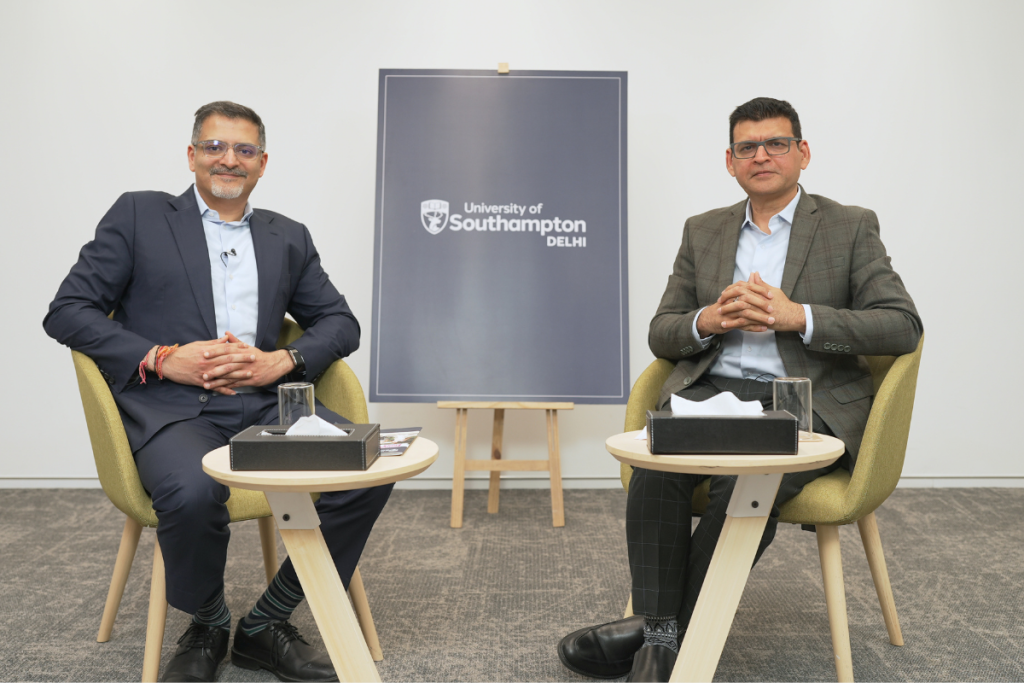
Speakers: Nitin Razdan, Partner and Human Capital Consulting Leader at Deloitte South Asia and Dr Vishal Talwar, Chief Operating Officer at University of Southampton Delhi.
Date: Monday 11 May 2026
This article is adapted from a recorded podcast discussion. Generative AI tools were used to assist with summarising and structuring the transcript into a blog format. The final content has been reviewed and edited by the author to ensure accuracy and alignment with institutional guidelines.