
Rethinking collaboration between university and industry: preparing students for the AI era
Artificial intelligence is transforming industries, reshaping how organisations operate and redefining the skills needed for the future workforce. One area experiencing significant change is the relationship between universities and industry. As AI technologies evolve, collaboration between academia and business is becoming essential to prepare students for real world challenges. During a recent webinar led by […]
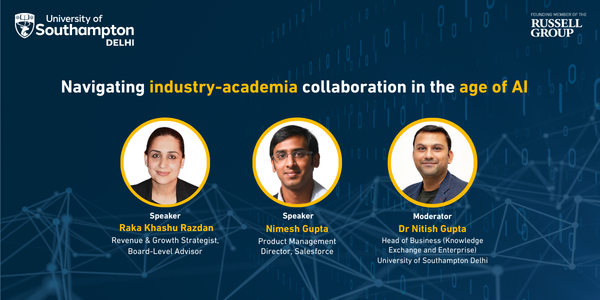
Artificial intelligence is transforming industries, reshaping how organisations operate and redefining the skills needed for the future workforce.
One area experiencing significant change is the relationship between universities and industry. As AI technologies evolve, collaboration between academia and business is becoming essential to prepare students for real world challenges.
During a recent webinar led by Dr Nitish Gupta and other industry leaders, they discussed how education must evolve to keep pace with rapid technological change.
Why AI in education matters
The traditional relationship between universities and industry has always centred on two key areas. Knowledge creation within academic institutions and practical application within industry. Universities focus on research and theory while businesses focus on commercialisation and innovation. However, the rise of artificial intelligence means this model is changing rapidly.
To remain relevant, AI in education must move beyond theory and focus on real world application.
The shift towards real time collaboration
Historically, collaboration between universities and industry followed a sequential model. Research would take place in universities and later be applied by businesses. Today this approach is no longer sufficient.
AI driven industries require collaboration to happen simultaneously. Universities and companies must work together in real time to address complex problems. This means moving beyond short term initiatives such as internships and hackathons towards long term partnerships that encourage:
- Continuous knowledge exchange
- Joint innovation projects
- Solving real business problem
Integrating AI into teaching and learning
One of the most important questions raised during the webinar was how educators can successfully integrate AI into teaching. The solution is not simply introducing tools like ChatGPT into classrooms. Instead, institutions must rethink their teaching strategies.
Educators need to consider how AI fits within:
- Course design
- Assignments and assessments
- Learning outcomes
Transparency is also essential. Students should clearly explain how they have used AI tools in their work, whether for research, idea generation or drafting content. This approach allows universities to encourage innovation while maintaining academic integrity.
AI careers: Choosing the right path
Many students are asking the same question. Which degrees will create the best opportunities in artificial intelligence? The answer is not always straightforward.
Rather than focusing solely on AI related degrees, students should focus on how AI can be applied to different industries. Opportunities exist across sectors including:
- Healthcare
- Finance
- Logistics
- Marketing
- Technology
Employers are increasingly looking for graduates who can apply AI to solve practical challenges, improve efficiency and generate business value.
Bridging the AI knowledge gap
Another important discussion focused on access to AI education, particularly for students outside major cities.
With the growth of online learning platforms, knowledge is now widely accessible. Platforms such as YouTube and other online learning hubs offer thousands of tutorials and courses covering artificial intelligence. However, access to information alone does not guarantee learning success.
Students often benefit from:
- Structured learning environments
- Consistent guidance from educators
- Opportunities for practical experimentation
These elements help transform theoretical knowledge into real skills.
Learning AI through practical experience
Experts emphasised that the best way to understand artificial intelligence is through hands on experimentation. Experiential learning allows students to:
- Work directly with AI tools
- Test and refine ideas
- Evaluate outputs and improve results
This process helps students develop key skills such as prompt design, contextual thinking and critical evaluation of AI generated outputs.
Learning AI is not a one time process. It requires continuous experimentation and adaptation.
Generative AI in creative industries
Artificial intelligence is also transforming creative sectors, particularly marketing.
Tools such as Google Gemini and NotebookLM can now generate marketing assets, summaries long form content and even create video outputs in seconds. For marketers, this means significantly faster production cycles. Campaign development, content creation and client engagement can now happen much more quickly than before.
However, human creativity and strategic thinking remain essential. AI works best as a collaborative tool that enhances human expertise rather than replacing it.
Ethical questions around AI ownership
As AI becomes more advanced, ethical questions are becoming increasingly important. One key debate focuses on ownership. If an AI system generates something completely new, who owns the output?
Many AI models operate as complex systems where the decision-making process is difficult to trace. This has led to increased interest in explainable AI and greater transparency around how outputs are generated. While the technology continues to evolve, most experts believe that responsibility and ownership still rest with the human guiding the process.
Global AI frameworks and local context
Universities around the world are developing policies to guide responsible use of AI.
Institutions such as the University of Southampton are introducing frameworks focused on responsible AI, critical thinking and academic integrity. However, applying global frameworks to local contexts can be challenging.
In countries such as India, universities must also consider factors such as language diversity, access to technology and varying levels of digital infrastructure. This highlights the importance of adapting AI strategies to local educational environments.
Preparing students for an AI driven economy
Artificial intelligence is reshaping the labour market. Experts predict a shift in demand across different skill levels. Lower skill tasks are increasingly automated while mid-level roles are shrinking. At the same time, demand for higher level analytical and problem-solving skills is growing. This places new pressure on universities to ensure students develop abilities such as:
- Critical thinking
- Complex problem solving
- Strategic decision making
AI should not replace human thinking. Instead, it should support deeper learning and innovation.
The future of AI in education
The future of AI in education depends on strong collaboration between universities and industry. By sharing knowledge, encouraging experimentation and promoting continuous learning, both sectors can prepare students for a rapidly changing world.
Students themselves also play an important role in this ecosystem. They act as connectors between academic research and real-world application. As artificial intelligence continues to evolve, education must evolve alongside it to ensure the next generation is ready to innovate, adapt and lead.
To explore these insights in more detail, watch the full webinar and hear directly from the experts.
Our expert panel included:
Dr Nitish Gupta: Head of Business (Knowledge Exchange and Enterprise) University of Southampton Delhi
Raka Khashu Razdan: Revenue & Growth Strategist, Board-Level Advisor
Nimesh Gupta: Product Management Director, Salesforce
Date: xxxxxxxx 2026
This article is adapted from a recorded webinar discussion. Generative AI tools were used to assist with summarising and structuring the transcript into a blog format. The final content has been reviewed and edited by the author to ensure accuracy and alignment with institutional guidelines.